Behind the hoop
Hand Embroidery vs Machine Embroidery: An Honest Side-by-Side
Both have their place. Here is an honest look at hand embroidery vs machine embroidery: how each is made, how to spot the difference and which one fits your project.
By Harshit Soni · Published · Updated
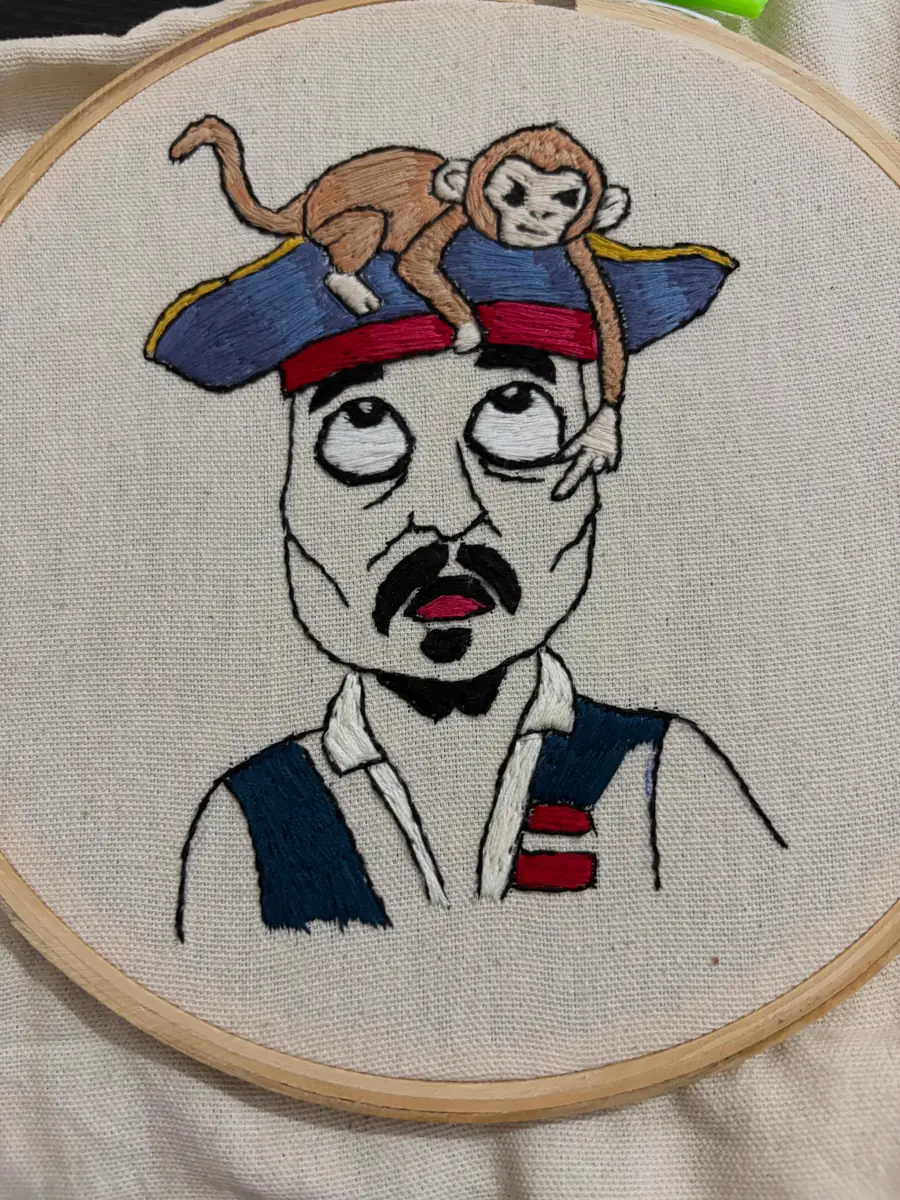
In hand embroidery vs machine embroidery, the core difference is who places each stitch. Hand embroidery is stitched by a person with a needle, so every piece is unique, softly textured and easy to personalise. Machine embroidery is stitched automatically from a digitised file, making it fast, uniform and ideal for logos, uniforms and bulk orders.
Scroll through any shopping app in India and you will see embroidered tees, cushion covers and wall hangings at every price. Some are stitched by a person with a needle, and some come off a machine in minutes. If you have ever wondered what really separates hand embroidery vs machine embroidery, and whether the difference is worth caring about, this guide is for you.
We are a hand-embroidery studio, so we are obviously fond of needle and thread. But machine embroidery is a brilliant technology that does some jobs far better than any human could. The aim here is not to declare a winner. It is to help you understand what you are buying, or what you want to make, so you can choose well.
We will walk through how each is made, how they look and feel, how to tell them apart, and which one suits gifts, portraits, clothing and bulk orders.
Key takeaways
- Hand embroidery is placed one stitch at a time; machine embroidery follows a digitised stitch file.
- Machines win on speed, identical repeats and lower cost per piece at volume.
- Hand embroidery wins on expressive faces, soft shading, raised texture and one-off personalisation.
- The back of a piece is the quickest clue: machine work often shows stabiliser and regular bobbin thread.
- Both last well with gentle care: wash cool, never wring and iron from the back.
What is hand embroidery?
Hand embroidery is decorating fabric using a needle and thread held and guided by hand. Every stitch is placed individually. The embroiderer decides its length, direction and tension, and can change their mind at any moment.
At Haré Creations, every piece starts as a drawing. We sketch the design, transfer it to cotton-linen fabric stretched in a wooden hoop, and stitch it with stranded cotton. Outlines, faces and lettering are usually worked in backstitch, smooth fills in satin stitch, shading in long and short stitch, and raised texture in French knots and floral stitches.
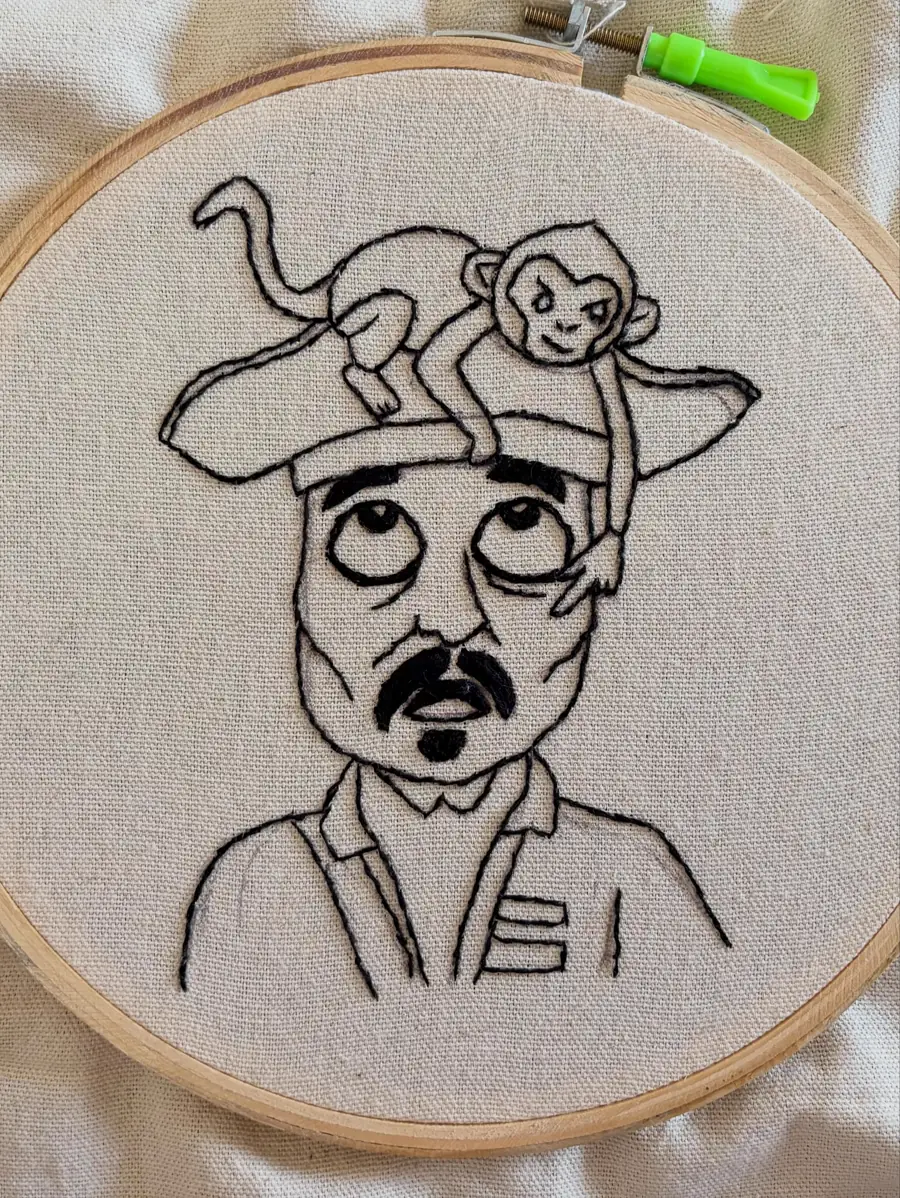
India has a deep tradition of hand embroidery, from regional styles passed down through families to the everyday skill of stitching a name onto a school bag. Contemporary hoop art is one more branch of that long story.
What is machine embroidery?
Machine embroidery uses a computerised embroidery machine to stitch a design automatically. The design is first converted into a stitch file, a process called digitising, which tells the machine exactly where each stitch goes, in what order and in which colour.
The fabric is held in a frame, usually with a stabiliser material behind it to stop it shifting or puckering. The machine then stitches at high speed, pausing for thread colour changes. Industrial machines can have many heads, stitching the same design on several garments at once.
- Strengths: speed, consistency, identical repeats, and cost efficiency at volume.
- Common uses: logos on uniforms and caps, corporate gifts, school badges, bulk merchandise and fashion trims.
- Typical threads: often polyester or rayon, chosen for durability and shine.
What is the difference between hand and machine embroidery?
The key difference is that hand embroidery is placed stitch by stitch by a person, while machine embroidery is stitched automatically from a digitised file. Individual pieces vary, but these are the patterns you will see most often.
| Factor | Hand embroidery | Machine embroidery |
|---|---|---|
| How it is made | Needle and thread guided by hand | Computerised machine from a digitised file |
| Look | Soft, dimensional, slight natural variation | Flat, dense and very uniform |
| Detail and shading | Single strands and gradual blending | Fine detail depends on digitising |
| Speed | Slow, suited to one-off pieces | Fast, suited to large quantities |
| Personalisation | Every piece can be different | New designs need re-digitising |
| Best for | Gifts, portraits, character art | Logos, uniforms, bulk orders |
Look and texture
Hand embroidery tends to have a softer, more dimensional look. Stitch lengths vary slightly, shading can blend gradually, and techniques like French knots add raised texture. Machine embroidery is typically flatter and very uniform, with dense, even fills and crisp edges.
Detail and shading
A hand embroiderer can split thread down to a single strand to capture a tiny expression, then blend several shades for skin tones or fabric folds. Machine designs can include fine detail too, but very small lettering, subtle gradients and delicate faces depend heavily on the digitising and are often simplified.
Speed and volume
This is where machines shine. A design that takes a hand embroiderer days can be stitched by machine in minutes, and repeated identically hundreds of times. Hand embroidery is slow by nature, which makes it suited to one-off or small-batch pieces.
Personalisation
Machine embroidery is great for repeating one design. Changing it means re-digitising. Hand embroidery is naturally one of a kind, so every piece can be different: a pet's exact markings, a couple's favourite outfit, a name in flowers that match someone's wedding colours.
Cost
Because hand embroidery takes so much more time, it usually costs more than machine embroidery of a similar size. With machine work, much of the cost is in setup, so per-piece costs drop as quantities rise. We cover what goes into pricing handmade work in our post on handmade embroidery pricing.
Feel and flexibility
Machine embroidery with heavy fills and stabiliser can feel stiff on a garment. Hand embroidery on clothing usually sits a little softer and moves more with the fabric, though very dense hand fills can stiffen fabric too.
How can you tell hand embroidery from machine embroidery?
You can tell hand embroidery from machine embroidery by checking the back, the uniformity of the stitches and whether identical copies exist. Sellers sometimes describe machine work as handmade, and some machine designs imitate a hand-stitched look, so a few simple checks help.
- Turn it over: machine embroidery often shows a stabiliser backing and a regular pattern of bobbin thread, sometimes white, running down the centre of satin areas. Hand embroidery usually shows the same colours on the back, with knots, thread tails and a less regular pattern.
- Check uniformity: machine stitches are near identical in length and spacing. Hand stitches vary slightly, especially in satin and long and short areas.
- Look for jump threads: machine pieces sometimes have tiny trimmed threads where the machine travelled between sections.
- Compare repeats: if a seller has many identical copies of a detailed design, it is likely machine-made.
- Watch the edges: hand-stitched outlines in backstitch have visible individual stitches; machine outlines are often continuous satin columns.
No single sign is proof on its own, so look at several together. And ask the maker. Anyone who stitches by hand is usually happy to share photos of the process.
Common myths about hand embroidery vs machine embroidery
The most common myths are that machine embroidery is always low quality and that handmade means perfect, and neither is true. Here is a more balanced view.
- Myth: machine embroidery is always low quality. Good digitising, quality thread and a well-maintained machine can produce excellent, long-lasting results.
- Myth: handmade means perfect. Hand stitching has small, natural variations. That is part of its charm, not a flaw.
- Myth: hand embroidery cannot be washed. Hand-stitched clothing in stranded cotton handles gentle hand washing well when cared for properly.
- Myth: you cannot customise machine embroidery. You can, but each new design needs to be digitised, so it suits repeats more than one-offs.
- Myth: they look the same in photos, so it does not matter. In person, the texture, softness and depth of hand stitching are much easier to see and feel.
Questions to ask before you buy
If you are shopping for embroidery and want to know what you are getting, a few friendly questions help:
- Is this stitched by hand or by machine?
- Can you share photos of the piece in progress?
- What thread and fabric do you use?
- Can the design be changed or personalised?
- How should I care for it once it arrives?
A maker who works by hand will usually be glad to answer, and many love showing the journey from sketch to finished piece. We share ours in from sketch to stitch.
Is hand embroidery better than machine embroidery?
Hand embroidery is not always better than machine embroidery; the right choice depends on the job. Better means different things for a school uniform and for a wedding gift.
Choose machine embroidery when
- You need many identical pieces, such as uniforms, team jerseys or event merchandise.
- You need a logo reproduced exactly the same every time.
- You are working with a tight budget per piece at large quantities.
- You need a quick turnaround on a simple, repeatable design.
Choose hand embroidery when
- You want a one-of-a-kind gift for a birthday, anniversary, Raksha Bandhan or Diwali.
- The design needs expressive faces, soft shading or fine character detail.
- You want raised, tactile textures like French knots and blooming florals.
- You value knowing that a person drew and stitched the piece just for you.
- You want to be involved, approving a sketch and requesting tweaks before stitching begins.
Why does Haré Creations stitch everything by hand?
Everything at Haré Creations is drawn and stitched by hand. No machines, no prints. That is not because machines are bad, but because the pieces we love making need a human touch.
Our fan-art inspired character hoops depend on expressions. The slight smirk on Captain Jack, the mood of Billy Butcher sprawled on a red couch, the grin of Luffy holding carrots: these come from choosing stitch direction and thread strands moment by moment. You can see that kind of work in our pop culture hoops, such as Butcher on the red couch.
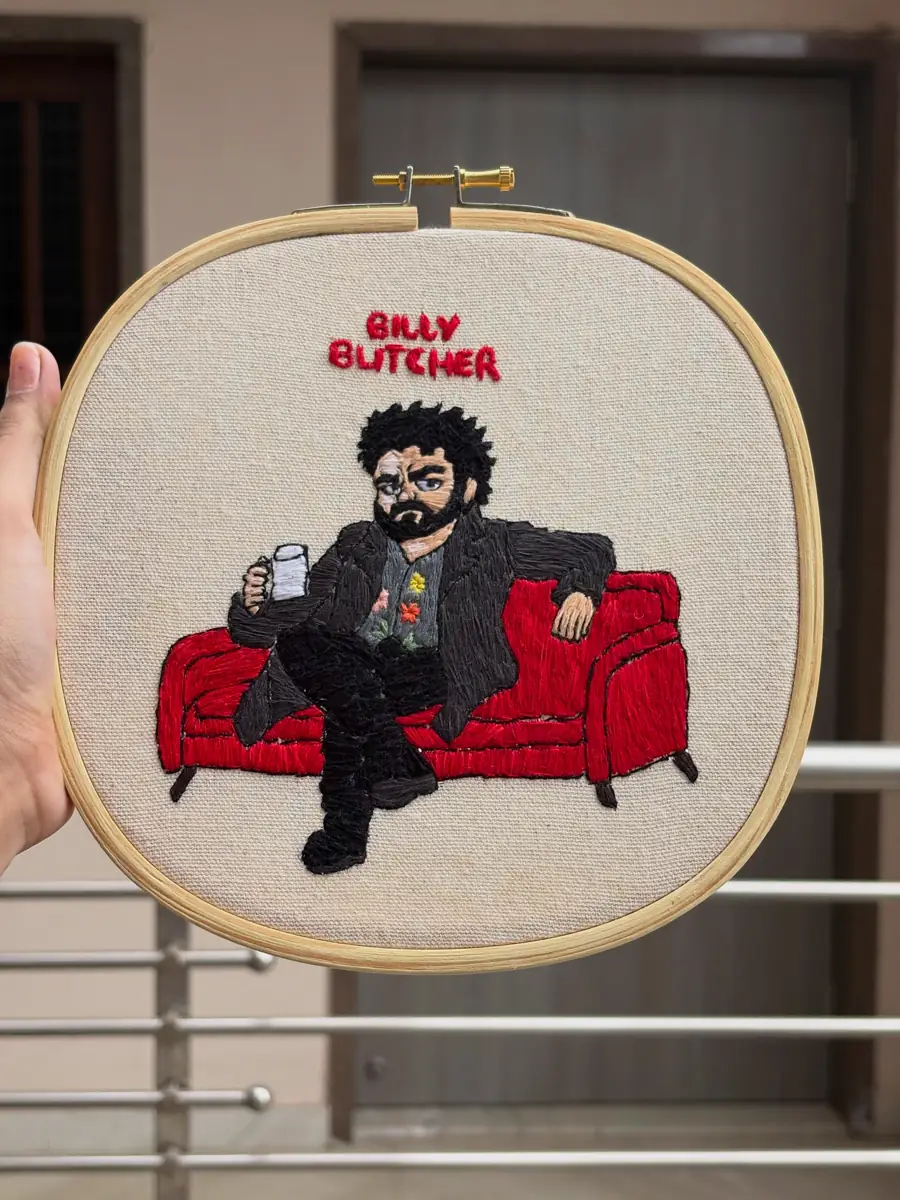
Custom cartoon portraits of people, couples and pets work the same way. Each face is different, so each needs its own drawing and its own shading decisions. Read more in our post on the custom embroidered portrait.
How does a hand-embroidered custom order work?
A hand-embroidered custom order with us works in five steps, from sharing your idea to receiving the finished piece:
- You share your idea through the custom order form or an Instagram DM.
- We draw a sketch and share it with you, along with the price and estimated timeline.
- You approve it or ask for tweaks.
- We stitch it by hand, stage by stage.
- It is checked, packed with care and sent to you.
You can follow each stage, from pencil lines to final details, on our process page.
How do you care for hand and machine embroidery?
Both kinds of embroidery last longer with gentle care. Wash cool and inside out, avoid bleach, never wring, dry flat in shade and iron from the back on a towel. Hand embroidery with stranded cotton handles gentle washing well, and hoop art on the wall simply needs dusting and a spot away from direct sunlight.
Machine embroidery with a stabiliser backing may feel slightly stiffer after washing, while hand embroidery can soften over time. With either kind, deep colours are worth testing for bleeding before the first wash, and a quick check for loose threads now and then helps you catch small issues early.
Frequently asked questions
What is the main difference between hand embroidery and machine embroidery?
Hand embroidery is stitched one stitch at a time by a person with a needle, so each piece is unique and can carry fine shading and texture. Machine embroidery is stitched automatically from a digitised file, making it fast and identical every time.
Why does hand embroidery cost more?
Mostly because of time. A detailed hand-embroidered piece can take many hours of drawing and stitching, while a machine can stitch a similar-sized design quickly once it is digitised. With hand work you are paying for skill and hours rather than machine time.
Is machine embroidery more durable than hand embroidery?
Not necessarily. Durability depends on the thread, fabric, stitch density and care. Well-made hand embroidery with good cotton thread can last a long time with gentle washing, and so can well-made machine embroidery.
Can machine embroidery look handmade?
Some machine designs are digitised to imitate hand stitches, and they can look convincing at a glance. Checking the back, the uniformity of stitches and whether identical copies exist usually reveals the difference.
Is hand embroidery a good gift?
It makes a thoughtful gift because it is personal and one of a kind. A hand-stitched name, portrait or character piece shows the time and care behind it, which is why many people choose it for special occasions.
The verdict on hand embroidery vs machine embroidery
When it comes to hand embroidery vs machine embroidery, there is no single winner. Machines are the smart choice for volume, logos and identical repeats. Hand embroidery is the choice when you want character, texture, personalisation and a piece that exists only once.
If that second list sounds like what you are after, share your idea on our custom order form. We will draw your sketch and share the price and timeline with it, then stitch it by hand, one thread at a time.
Topics: hand embroidery vs machine embroidery, difference between hand and machine embroidery, how to identify hand embroidery, is hand embroidery better than machine embroidery, why is hand embroidery expensive, hand embroidery gifts india, custom hand embroidered portrait, machine embroidery for logos and uniforms